Tuesday, 4 January 2011

Water Pipit, a first for Shetland

Unst managed to turn up its second first for Shetland in 2010 with a Water Pipit at Norwick on 21st-23rd November. Here is a finder's account from Brydon Thomason.
Water Pipit at Norwick by Jim Nicolson
November is traditionally a month never to be underestimated when considering winding down an autumn birding in the isles. It is a month that seldom passes without at least one surprise rarity. Personally speaking, November has indeed been more than kind and has brought  a diversity of  rarity finds such as Gyrfalcon, Lesser Scaup and Hume’s, Arctic and Dusky Warblers, to name but a few - along with multiple King Eider and White-billed Divers.

With that said though, it can certainly be a hard month to keep motivation going when out in the field. Migrants can be very few and far between and suitable habitat and cover for a potential rarity is often all but weathered away.

Although birding time had been at something of a premium, I had still had my usual November aspirations of finding Pine Bunting or Desert Wheatear but, alas, once again it was to be a year of neither! But what I was to find, in a local context at least, was to be a much rarer bird than either of these ...


It was our son Casey's belated first birthday party so, with the Sunday dinner preparations all in hand, and along with my parents, wife Vaila and our birthday boy we set out for a nice pre- dinner outing. Having enjoyed a lovely walk at Skaw beach we made time for a drive along the shore-side road which overlooks one of Shetland’s iconic vistas, Norwick beach. 

As we drove towards the turning point, a passerine flitted over the verge and down toward the beach. I caught no more than a fleeting glimpse, but what I did see certainly intrigued me; the amount of white in the outer tail suggested pipit, but perhaps even a bunting or lark were all possibilities given how poorly I’d seen it. In any case any pipit, lark or bunting in late November is worth checking; they are few and far between by late November.

Leaving the car running and family in it, I peered over the bank and down onto the dead seaweed smothered beach only to see a female Black Redstart fly away from me - confused, my eyes quickly then fixed on my mystery bird flying off along the beach. It was certainly a pipit, but which? It showed quite a lot of white in the outer tail and seemed to show some brownish tones. I knew something was unfamiliar about it as I watched it fly to the far end of the beach. I quickly shouted to Vaila to come back for me ‘in a bit’, having no earthly idea how long that would be!      

I relocated the bird at the far end and got my first ‘on the deck views’. It was some 40-50yards away and I had no scope! The split second thoughts of Blyth’s (more by its apparent choice of habitat than anything else, feeding along the edge of dunes) were expelled instantly, not least on plumage tones and underpart streaking but also structure.

Its underparts were strikingly clean white, plus the white in the tail ruled out local Rock Pipit and I was fairly certain littoralis was not in the picture either. Water or Buff-bellied Pipit were all that were possible, I thought to myself. Without even getting the chance to stalk forward and get better views, a dog walker flushed it, causing it to fly over my head and all the way back to the far end of the beach, calling once as it went - a rather flat Rock Pipit like ‘psp’- surely it must  be  a Water Pipit?  

It had been several years since I had heard Buff-bellied Pipit in the States but I was pretty confident this was not one. I began to really train my thoughts on Water Pipit, a species I had never even seen in Britain, and not since a UAE trip many years ago, and even there I had admittedly paid them little attention. BBP was very much fresh on my radar having seen the bird at Eshaness only a few weeks previously, but this was just never coming across with a Buff-bellied Pipit vibe to me.

When I returned to the other end, my father was at the wheel of my Freelander and informed me the others were back home (only a few minutes up the road). I grabbed my scope but had no tripod with me. A blustery and very anxious few seconds through the scope for the first time appeared to confirm to me the following basics;
·          Tail, coverts and tertials did not appear strikingly blackish or crisply fringed as in BBP
·         The mantle appeared to be visibly streaked as opposed to rather plain BBP
·         Streaking on clean white underparts was quite bold all the way down flanks
·         Slightly browner tones around rump area
·         Perhaps most importantly the lores appeared to be quite distinctly marked and not open
·         Nor did it show the striking eye crescents of BBP - It had to be a Water Pipit I thought to myself.

Water Pipit at Norwick by Rob Brookes

All this had happened in under ten minutes, it was just after 1500 and light was failing fast, I had to get news out to the ‘Unst boys’. Unusually, I had no camera with me nor did I even have a field guide to hand. We drove off up the road to get phone reception and where Mr P (Mike Pennington) was my first and very definitely priority call. Thankfully he answered and within ten minutes was by my side followed swiftly by Robbie Brookes – I knew young Rory T was off island.

Water Pipit was certainly a first for Unst and I was also aware that it would almost certainly be a new species for all the Shetland ‘listers’ but didn’t actually realise at the time it was in fact a county first! Whilst anxiously trying to relocate the bird with Mr P I relayed all that I had noted. Thankfully without too much distress (although perhaps maybe with a little ‘tension’ in the air!) we pinned it down back feeding on the dead kelp on the tide line of the beach, which proved to be its favourite spot. We enjoyed fairly good and definitively conclusive views through a shared scope but with light that was by now bordering on appalling neither Mike nor Rob got anything better than poor record shots.

By about 1530 we had lost the bird due to poor light. On route home we put the news out and I was back home in time for getting the ‘tatties’ on and set the table - a county first and my son's first birthday party, the perfect Sunday!

Friday, 3 December 2010

A Round-up of Killer Whale Sightings involving Shetland in 2010

by Andy Foote, Brydon Thomason and Suzanne Beck
 

Even as this year draws to a close there have been Killer Whale sightings around Shetland. So it seems like a good time to look back at the comings and goings of our Killer Whales during 2010.

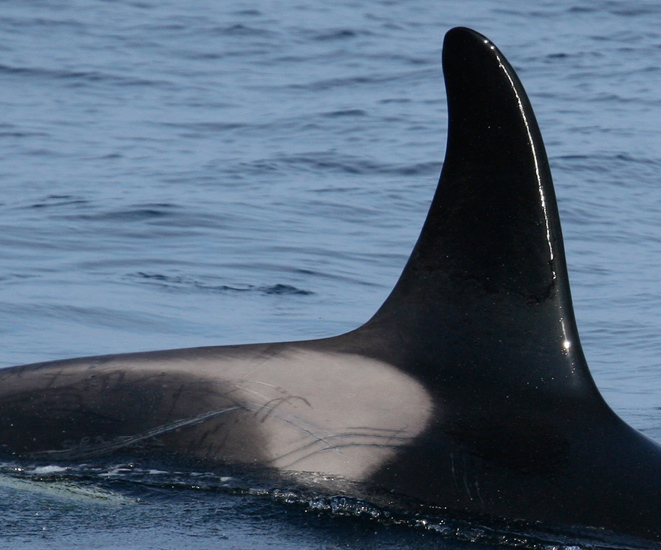
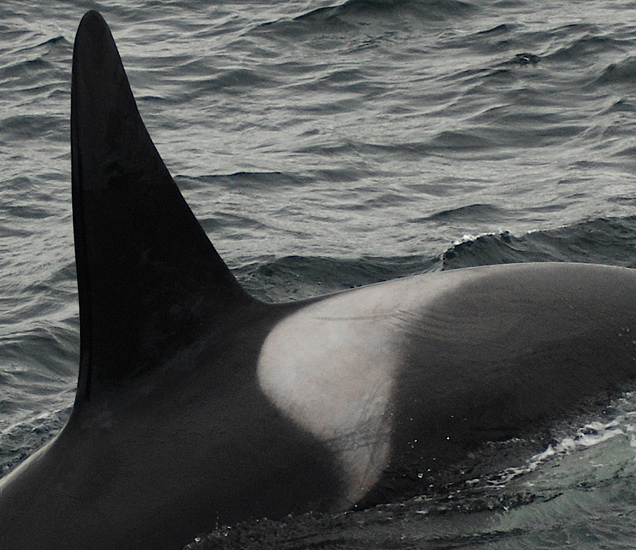
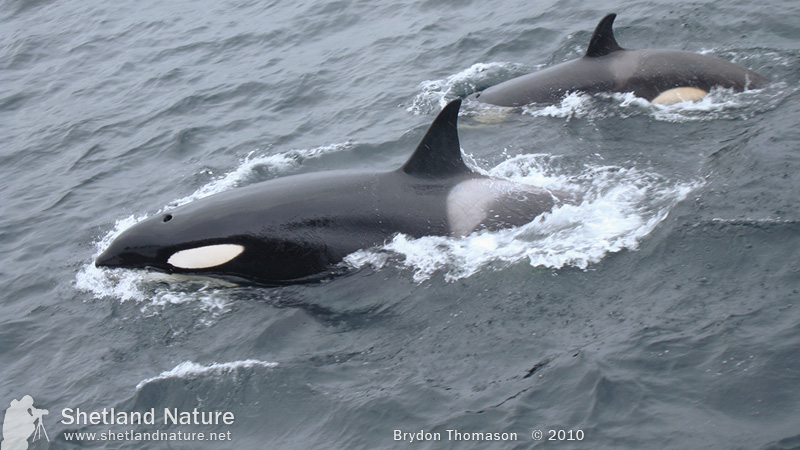
The first whales showed up in late March (23rd) in Yell Sound, which is consistent with the past few years. We got a chance to photograph them from the Yell Sound ferry, but the sun was working against us and the images were backlit and we couldn’t really positively ID any of the whales. One of the female-sized fin silhouettes however had two distinctive notches in the trailing edge, which looked very much like the female with ID number 12. But other individuals had silhouettes that did not match any of the fins in our photo-id catalogue, and so it seems like we had some new whales!

The new individuals appeared to stick around for a couple of weeks as the fin shapes match with those seen hunting in Scalloway harbour only days later on the 28th March and with 2 males photographed in Yell Sound on the 8th April.


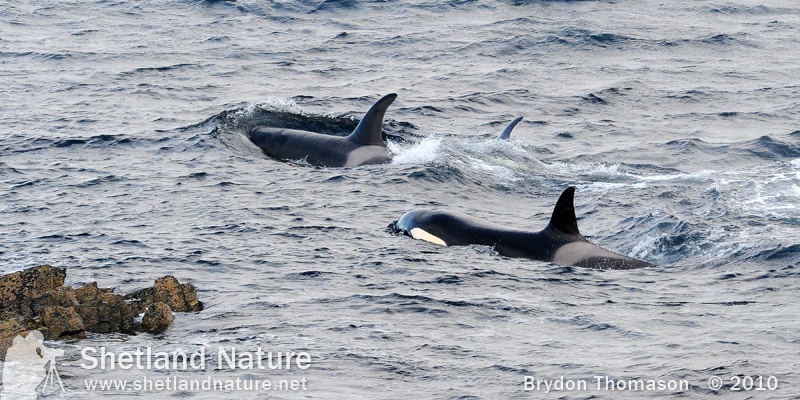
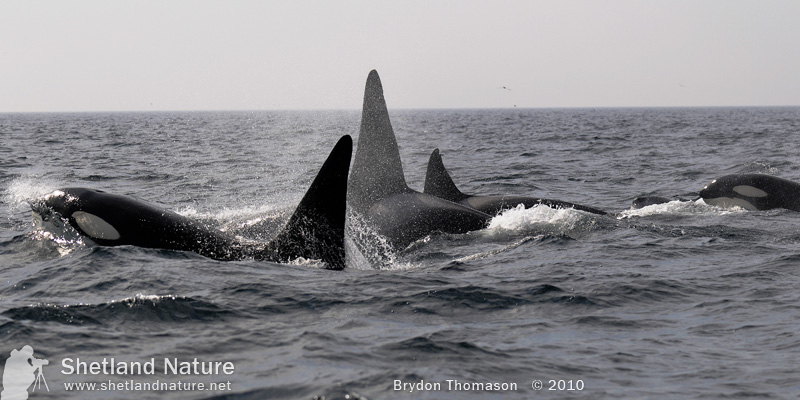
May was a quiet month around Shetland, and all the action was further south. The group of four (27, 34, 72 & 73) that are regularly seen around Shetland showed up in Scapa Flow in Orkney (6th May) and they had a new calf! It appears as though 27 is it’s mum as it stayed closest to her in all the photos we were sent. The photo (above) of this pod was taken on Bluemull Sound on 15/03/08.

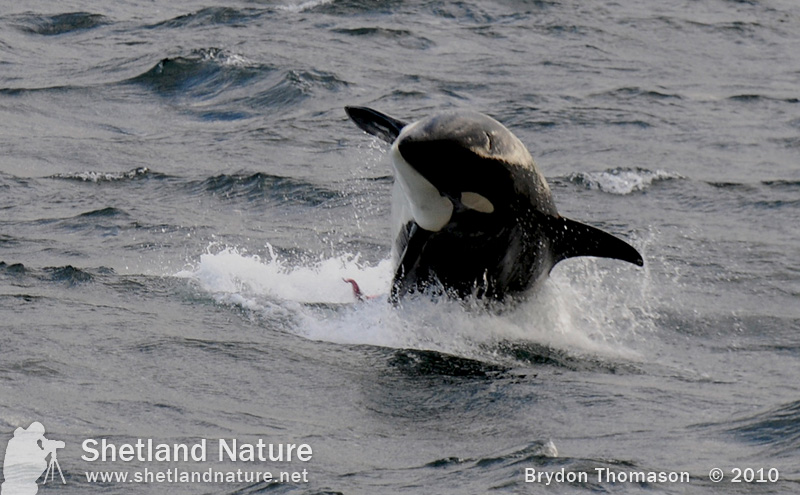
We got to follow this group's travels through a series of great photos provided by the public. On the 13th May they were seen off Durness in Sutherland, but they headed east again and were photographed on the 20th off Whaligoe steps, Ulbster, Caithness. They didn’t show up again until 23rd August when they were photographed off the Faeroes feeding on eiders and doing some hunting training with the youngsters, and even hit the headlines by making it on to the Faeroese evening news.

12 and her group were also sighted regularly in May, being photographed between Shapinsay and Kirkwall in Orkney on the 9th May, and then Duncansby Head, Caithness on 16th. They were back up to Orkney where they took a marine mammal in Eynhallow Sound on the 25th May, before heading south again, being seen back off Caithness on the 28th May. Then they headed west and were last positively identified off St Kilda on 12th June. They may have also paid a fleeting visit to Shetland as a group that looked like them were photographed on 8th July off Bressay, but it was choppy weather and the photos weren’t clear enough to be sure.

Larger groups of Killer Whales were also getting seen feeding on herring offshore about 25 miles east of Shetland during May. Photos we received were all of individuals not previously catalogued.


June was pretty quiet too, until on the 23rd a group of 5 showed up in Yell Sound and took either a seal or porpoise just off the ferry. This was the start of an unprecedented run of sightings from the Yell Sound ferry, with almost daily sightings for a month. Photos that we have received or collected ourselves between 23rd June and 24th July showed that most of these sightings were of the same group of 5, which were positively IDed on the 23rd June, 7th, 12th, 15th and 18th July. The group had not previously catalogued and it seems highly likely that they are newcomers to Shetland.


They weren’t the only group seen around Shetland at this time. As noted above the group on Bressay were definitely not the same group, and our old friend Bigga (ID number 14) was seen on his own off Gutcher on 10th July and again on two occasions over the following fortnight on Yell Sound.


Further south again, photographs came in of the group with female with ID number 15 (who we last saw in 2009 off Bluemull Sound). They were seen once off the Moray Firth on 29th June and then off Orkney on 20th July.

So, this year due to the amazing public contribution of photos, we’ve been able to track some pods as they have moved over quite a considerable distance, we’ve been able to monitor the birth of new calves, and we’ve seen what look like 2 sets of newcomers to the Northern Isles, suggesting that Killer Whale sightings in this area may be on the increase.

A massive thank you to everyone who contributed to this year’s efforts, the support continues to grow each summer!

Read more about the ID project at www.northatlantickillerwhales.com

This blogpost has also been published on www.shetlandnature.net - we would welcome further shared blogposts if they cover subjects of broad interest.

Thursday, 4 November 2010

Two new moths for Shetland

Every year, the small band of moth-trappers in Shetland catch a few moths that they are unable to readily identify, and by October have a fridge-full of deceased moths in pots. They are then magically sent away south to be identified by Jon Clifton of Anglian Lepidopterist Supplies (www.angleps.com). The results from 2010 have just come back, and have revealed two firsts for Shetland.

Sandy Carpet (Perizoma flavofasciata)
A moribund individual was trapped on 21st June 2010 by Rob Fray in his garden at Virkie. It was not photographed, but a photo of the species can be seen here.

This moth, which usually inhabits open woodlands, mature hedgerows, calcareous grassland and sand-dunes, is fairly common and widely distributed in England, Wales and southern Scotland. It flies during June and July, although does not come to light very often. It would appear to be spreading north, as it is not mentioned in the books on Orkney Lepidoptera which summarised records until the mid-1990s, but there are now widespread records on Orkney Mainland according to this map.

Splendid Brocade (Lacanobia splendens)
This was trapped by Paul Harvey in his garden at Virkie on 19th July 2010. Again, the specimen wasn ot photographed, but a photo of the species can be seen here.

This central and southern European species was first identified in Britain from a specimen captured at Portland, Dorset),on 1st July 2003, although earlier specimens which had been overlooked have been located since. Since then it has been recorded in the UK on a number of occasions, usually in southern England. It flies in June and July and typically frequents damp woodland and forests in its native range. Not only was this a first for Shetland, it was the first record of Splendid Brocade in Scotland.

On behalf of all who trap and record moths in Shetland, thanks to Paul Harvey and the Shetland Biological Records Centre for providing us with an easy facility to get our moths identified, and Jon Clifton for patiently wading through loads of common moths and locating these occasional little gems.

Friday, 8 October 2010

A fishy first for Shetland

Fish rarely feature on the Nature in Shetland website, but we received a press release the other day which is well worth reading as it describes a n interesting and endearing little fish and shows what there is that can still be discovered about Shetland's fauna.

Europe’s smallest marine fish, Guillet’s goby, has been found off the Shetland coast at Lunna, by two local divers, Rachel Hope and Richard Shucksmith.

This small fish called Guillet’s goby (Lebetus guilleti) only grows up to a maximum length of 24 mm (upper photo of male by Rachel Hope and lower photo of female by Richard Shucksmith). It was spotted by two local divers whilst shore diving at Lunna, Shetland. It is an extremely rare fish and was only described as a species in 1971. There are only a handful of sightings of this species around Europe including 4 in England and other sparse records are from the Mediterranean, northern Spain and one from the Kattegat (previously the most northerly record).  This species have never been recorded in Scotland and this finding extends the known range 140 miles further north.

Due to the importance of this sighting it has been accepted for publication in the peer reviewed Marine Biological Association Journal ‘Marine Biodiversity Records’.

Little is currently known about the Guillet's goby's biology. It seems to prefer living on rough ground such as shelly sand in shallow coastal waters and due to its small size it is able to hide between the shell fragments, making it extremely difficult to spot. Male and females have different colouration (sexual dimorphism), although both have mottled buff coloured bodies. However the male has a brightly coloured second dorsal fin with a blue spot and orange stripes, much like a brightly coloured butterfly.  Gobies are a family of small mostly bottom living fish and share a similar small and elongated body shape. They all have distinctive thick lips and bulbous eyes set close together near the top of the head.  

When we found this species the males and females were found as pairs together with the females appearing to be swollen with eggs. Normally in goby reproduction the male will choose the nest site such as an empty shell, or a crevice where the female will lay the eggs. The male will then guard the eggs until they hatch.  These pairs seem to indicate that these Guillet's goby is breeding in Shetland.

By finding this species in Shetland it means that its known range now must encompass the whole of the UK. Divers and scientists surveying around the coast should look out for this small and beautiful fish when diving or sampling over rough sediment types such as shelly sand or maerl. As more information is collected about this unusual species a clearer picture can be developed about its biology and distribution. It is possible that the spread of this species further north is a climatic range expansion or it could simply be that due its small size and cryptic colouration it has been overlooked.

Shetland is famous at migration time for its rare birds and this find shows that it should be famous for its rare marine life too!


Wednesday, 22 September 2010

Colour-ringed Whimbrel and Rock Pipit

During 1986-88, Murray Grant colour-ringed 97 Whimbrels to monitor brood survival and return rates of adults. Although sightings of these birds were reported from Fetlar until the 1990s, there had been none since. This summer, Allan Perkins was working in Unst and Fetlar studying the breeding success of Whimbrels, due to the worrying decline in thier numbers in the last few years. On 9th May he was rather surprised to spot a colour-ringed bird on Fetlar, although it was 31st May before he could confirm the colour-ring combination. It had originally been ringed as a breeding adult on Fetlar on 1st June 1986. At 24 years, this is easily the longevity record for this species and, as Whimbrels don't normally breed until they are two or three years old, this bird may well be over 26 years old.

More detail, and photos, are on the BTO Demog Blog.

A colour-ringed Rock Pipit which was breeding on Whalsay this spring is now known to have been ringed in at New Aberdour in North-east Scotland in February. It is the first proof of a Shetland breeding bird emigrating for the winter, although there is a a previous record of a Shetland-bred chick being found in Scotland. There are also several other records of full-grown birds ringed in Shetland and found in Scotland in winter. Although these could be migrants, the evidence would seem to suggest that a proportion of Shetand Rock Pipits leave the islands in winter.

In addition, a colour-ringed Starling seen on Out Skerries recently does not appear to be a Fair Isle bird - although it's origins are still being tracked down.

Monday, 6 September 2010

Our Eiders are Faroese

The latest edition of the BTO's journal Bird Study includes the following paper: Subspecies status of Common Eiders Somateria mollissima in Shetland based on morphology and DNA by Robert W. Furness, Barbara Mable, Fiona Savory, Kate Griffiths, Stephen R. Baillie and Martin Heubeck.

Using DNA from specimens of Eider found dead in Shetland, and biometric data collected from a cannon-netted sample ringed in the 1980s, it is concluded that Shetland Eiders are closely similar to birds from the Faroe Islands,  subspecies faeroeensis , and distinct from the nominate mollissima to which all Scottish Eiders
have been conventionally assigned.

Interestingly, Eiders from southern Iceland are more similar to faeroeensis according to DNA, despite differing in plumage and being assigned to a different subspecies borealis. As has been suspected for a while, they conclude that the taxonomy of the Common Eider group may be in need of revision.

The allocation of the Shetland Eider population to a new taxon, found nowhere else in the UK, has clear implications in conservation terms, especially as the population is in long-term decline.

Wandering Orcas

We received the following e-mail from Andy Foote recently, telling us about the wandering of one pod of Killer Whales which are regular visitors to Shetland, although as you can see they are now known to wander from at least Caithness to Faroe.


I thought the mammal watchers that check out the sea mammal sightings web page might be interested to know that one of our regular Shetland groups (27, 34, 73, 74 and 27's new calf 151) made it on to Faeroese TV this week, see below for the link. Hans Eli Sivertsen who sent me the link also took some great shots, and he also photographed the same group off the Faeroes last year. They were last seen in Scottish waters off Wick back in June.
cheers,
Andy


The link to Faroese TV is here, with the Orcas appearing towards the end (at about 19:20).

http://www.kringvarp.fo/click.asp?i=dov4293.wmv&f=k&t=m