Saturday, 12 January 2013
The first Norwegian-ringed White-tailed Eagle in Shetland
Tuesday, 20 November 2012
Tel. 01950 460304. Email: martinheubeck@btinternet.com).
Tuesday, 6 November 2012
Waxwings in Shetland in early November 2012
![]() |
| Waxwings at Baltasound, 3rd November 2012 - Rob Brookes |
![]() |
| Waxwings in Lerwick, 3rd November 2012 - Larry Dalziel |
![]() |
| Waxwing at Scalloway, 3rd November 2012 - Rob Fray |
Monday, 27 February 2012
IGC Goose Count weekend
Sunday, 15 January 2012
Iceland Gulls in January 2012
Iceland Gull is generally considered to be a scarce, but regular, winter visitor to Shetland in small numbers. From about January 7th 2012 larger than usual numbers began to appear in the islands, and it soon became clear that a major influx was taking place.With this in mind, a co-ordinated Shetland-wide count was organised by members of the Shetland Bird Club, and others, for Saturday 14th January. Observers were despatched far and wide to locate as many birds as possible, in order to try and record the influx as best as possible. We've received virtually everything now, although there may be one or two extras to add in later. Below is what we've come up with so far:
Unst (total 24)
Skaw - 4 (all 2nd-winters)
Norwick - 1 (2nd-winter)
Baltasound - 3 (all 2nd-winters)
Westing - 1 (2nd-winter)
Belmont - 13 (4 adults, 4 3rd-winters, 4 2nd-winters, 1 1st-winter)
Uyeasound - 2 (adult and 2nd-winter)
Yell (total 12)
North Sandwick - 7 (2 adults, 2 3rd-winters, 3 2nd-winters)
Mid Yell - 1 (2nd-winter)
Ulsta - 1 (2nd-winter)
Hamnavoe - 1 (2nd-winter)
Loch of Littlester - 1 (2nd-winter)
Burravoe - 1 (2nd-winter)
Fetlar (total 1)
Just one 2nd-winter on the island
Whalsay (total 22)
Symbister - 15 (5 adults, 3 3rd-winters, 4 2nd-winters (one of which was dead) and 3 1st-winters)
Hamister/North Voe - 2 (1 adult, 1 3rd-winter, both showing characteristics of Kumlien's Gull)
Skaw - 1 (adult)
Vaivoe - 1 (2nd-winter)
Challister - 1 (2nd-winter)
Brough - 1 (2nd-winter)
Huxter Loch - 1 (2nd-winter)
North Mainland (total 2)
Ronas Voe - 1 (2nd-winter)
South Collafirth - 1 (2nd-winter)
West Mainland (total 13)
Melby - 5 (1 3rd-winter, 3 2nd-winters, 1 1st-winter)
Burrastow - 8 (5 adults/3rd-winters, 3 1st/2nd-winters)
Central/East Mainland (total 55)
Firths Voe - 3 (1 adult, 2 2nd-winters)
Laxo - 3 (1 adult, 1 2nd-winter, 1 1st-winter)
Lunna - 1 (2nd-winter)
Dury Voe - 4 (2 adults, 2 2nd-winters)
Brettabister - 1 (1st-winter)
Scalloway - 6 (all 2nd-winters)
Loch of Tingwall - 1 (3rd-winter)
Lerwick - 36 in total; 35 (8 adults, 5 3rd-winters, 20 2nd-winters, 2 1st-winters) at Shetland Catch, and 1 (1st-winter) at Breiwick
South Mainland (total 15)
Sumburgh - 1 (adult)
Scatness - 1 (adult)
Fleck - 1 (adult)
Boddam - 1 (3rd-winter)
Clumlie - 2 (adult and 2nd-winter)
Scousburgh - 3 (2 2nd-winters, 1 1st-winter)
St Ninian's Isle - 1 (2nd-winter)
Gulberwick - 1 (1st-winter)
Wester Quarff - 4 (unaged)
Fair Isle (total 8)
2 adults, 1 3rd-winter, 5 2nd-winters (one of the 2nd-winters was found dead)
Grand total: 152
We'll continue to update the totals as and when more information is received.
There was some evidence that birds had moved on over the last few days (or relocated to other sites within the islands), particularly on Unst, where there had been 33 at Belmont on January 11th (compared to 13 on the 'count day') and 13 at Skaw on January 10th (compared to 4 on 'count day'). In addition, careful scrutiny of the ages of birds in Lerwick has shown that at least 44 individuals have been present during the last week.
It is fairly safe to say that the January 2012 influx is the largest to ever be recorded in Shetland. The previous biggest arrival was in January/February 1983, which produced at least 120 birds. In addition, the record site count has also been broken this year - the previous highest count at one individual site was 31 in Lerwick in January 1993.
An interesting aspect to the arrival in January 2012 is the make-up of the ages of the birds involved, with much larger numbers of 'older' birds than would normally be expected, and a strange dearth of 1st-winter individuals. This is something that we hope to expand upon in due course.Observers who specifically went out looking and participated in the co-ordinated counts were:
Rob Brookes (north Unst)
Mike Pennington (south Unst)
Brydon Thomason (Fetlar and north Yell)
John Lowrie Irvine and Brian Marshall (Whalsay)
Jim Nangle and Lynn Thomson (Yell)
Rob Fray (south Yell, central and east mainland)
Gary Bell (north mainland)
Rory Tallack (west mainland)
Paul Harvey and Pete Ellis (Lerwick)
Juan Brown (Scalloway, Tingwall Valley, Burra and Trondra)
Jim Nicolson and George Petrie (Cunningsburgh to Gulberwick)
Roger Riddington and Glen Tyler (south mainland)
Naomi Scott (Papa Stour)
David Parnaby and Tommy and Henry Hyndman (Fair Isle)
In addition, casual records that added to the totals were received from Martin Heubeck and Mark Chapman, and a couple of records have been gleaned from various news services.
Our grateful thanks to everybody who took part.
Rob Fray
Wednesday, 23 November 2011
Colour-ringed and neck-collared geese
There have been unusual numbers of geese around in the last few weeks, with European White-frontedGeese, Tundra Bean Geese, Pink-footed Geese and several other species joining the usual Greylags. In amongst all these new arrivals have been two birds with neck collars. Rory Tallack found a White-fronted Goose at Sandness on Sunday 20th November (photo by Rory Tallack).It was probably marked in its wintering grounds in Germany or the Netherlands.
Saturday, 10 September 2011
Your Shetland List may have just gone up by 2!
Tuesday, 4 January 2011
Water Pipit, a first for Shetland
![]() |
| Water Pipit at Norwick by Jim Nicolson |
![]() |
| Water Pipit at Norwick by Rob Brookes |
Friday, 3 December 2010
A Round-up of Killer Whale Sightings involving Shetland in 2010
Even as this year draws to a close there have been Killer Whale sightings around Shetland. So it seems like a good time to look back at the comings and goings of our Killer Whales during 2010.
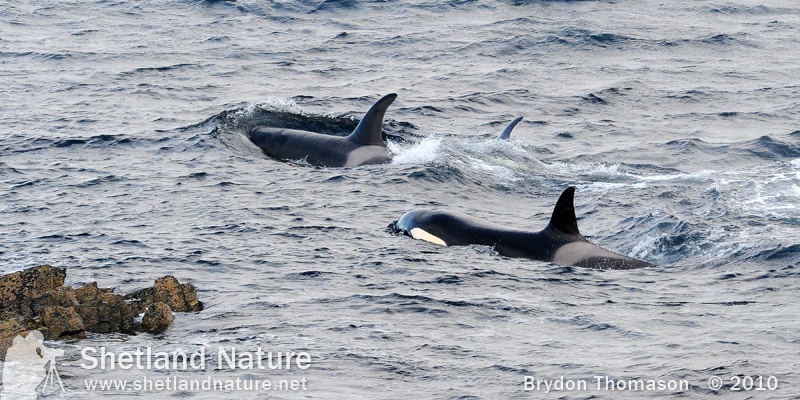
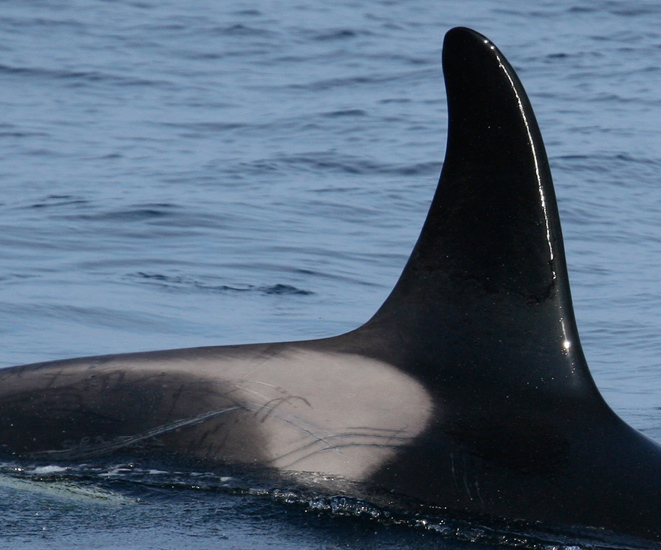
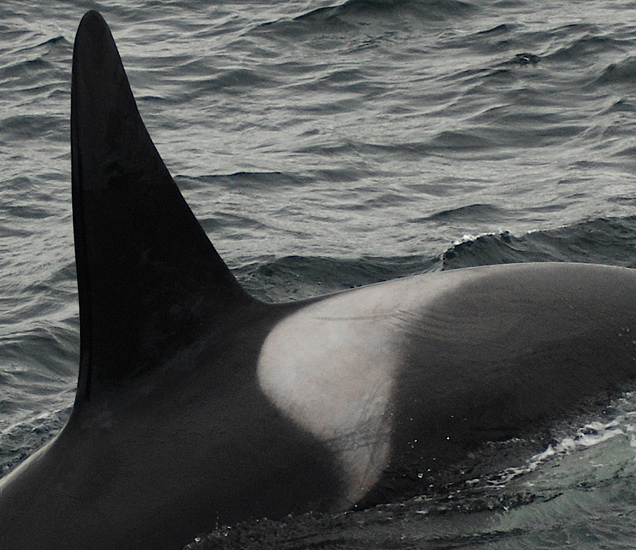
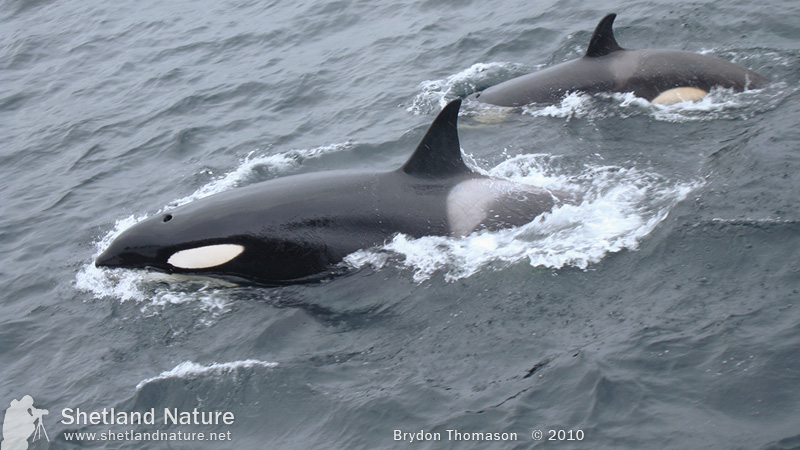
The first whales showed up in late March (23rd) in Yell Sound, which is consistent with the past few years. We got a chance to photograph them from the Yell Sound ferry, but the sun was working against us and the images were backlit and we couldn’t really positively ID any of the whales. One of the female-sized fin silhouettes however had two distinctive notches in the trailing edge, which looked very much like the female with ID number 12. But other individuals had silhouettes that did not match any of the fins in our photo-id catalogue, and so it seems like we had some new whales!
The new individuals appeared to stick around for a couple of weeks as the fin shapes match with those seen hunting in Scalloway harbour only days later on the 28th March and with 2 males photographed in Yell Sound on the 8th April.
May was a quiet month around Shetland, and all the action was further south. The group of four (27, 34, 72 & 73) that are regularly seen around Shetland showed up in Scapa Flow in Orkney (6th May) and they had a new calf! It appears as though 27 is it’s mum as it stayed closest to her in all the photos we were sent. The photo (above) of this pod was taken on Bluemull Sound on 15/03/08.
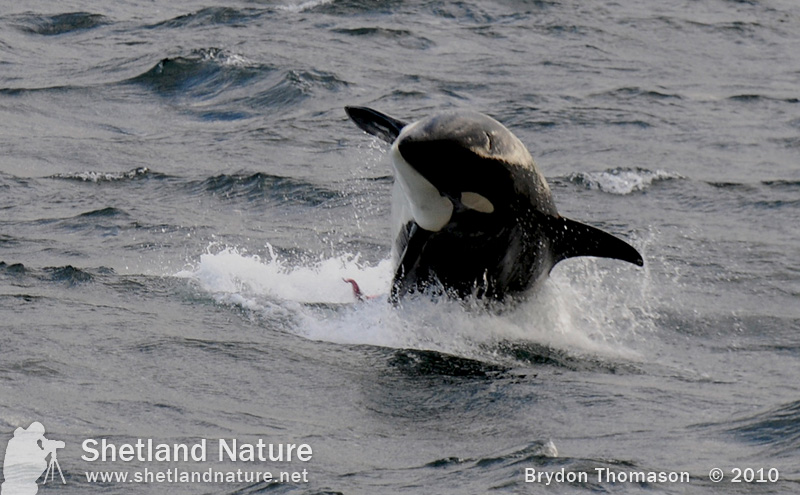
We got to follow this group's travels through a series of great photos provided by the public. On the 13th May they were seen off Durness in Sutherland, but they headed east again and were photographed on the 20th off Whaligoe steps, Ulbster, Caithness. They didn’t show up again until 23rd August when they were photographed off the Faeroes feeding on eiders and doing some hunting training with the youngsters, and even hit the headlines by making it on to the Faeroese evening news.
12 and her group were also sighted regularly in May, being photographed between Shapinsay and Kirkwall in Orkney on the 9th May, and then Duncansby Head, Caithness on 16th. They were back up to Orkney where they took a marine mammal in Eynhallow Sound on the 25th May, before heading south again, being seen back off Caithness on the 28th May. Then they headed west and were last positively identified off St Kilda on 12th June. They may have also paid a fleeting visit to Shetland as a group that looked like them were photographed on 8th July off Bressay, but it was choppy weather and the photos weren’t clear enough to be sure.
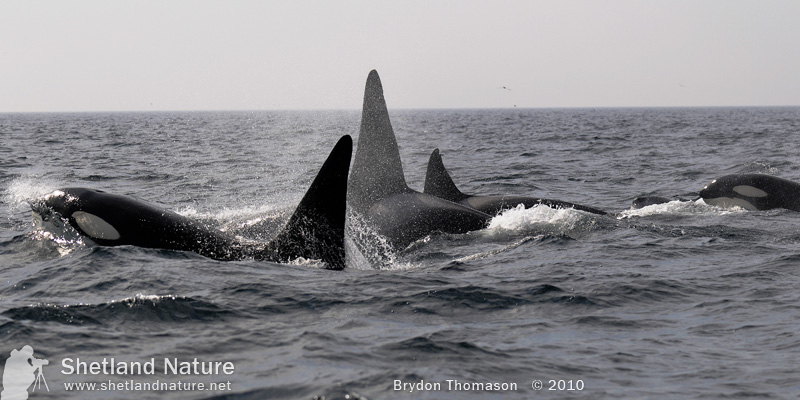
Larger groups of Killer Whales were also getting seen feeding on herring offshore about 25 miles east of Shetland during May. Photos we received were all of individuals not previously catalogued.
June was pretty quiet too, until on the 23rd a group of 5 showed up in Yell Sound and took either a seal or porpoise just off the ferry. This was the start of an unprecedented run of sightings from the Yell Sound ferry, with almost daily sightings for a month. Photos that we have received or collected ourselves between 23rd June and 24th July showed that most of these sightings were of the same group of 5, which were positively IDed on the 23rd June, 7th, 12th, 15th and 18th July. The group had not previously catalogued and it seems highly likely that they are newcomers to Shetland.
They weren’t the only group seen around Shetland at this time. As noted above the group on Bressay were definitely not the same group, and our old friend Bigga (ID number 14) was seen on his own off Gutcher on 10th July and again on two occasions over the following fortnight on Yell Sound.
Further south again, photographs came in of the group with female with ID number 15 (who we last saw in 2009 off Bluemull Sound). They were seen once off the Moray Firth on 29th June and then off Orkney on 20th July.
So, this year due to the amazing public contribution of photos, we’ve been able to track some pods as they have moved over quite a considerable distance, we’ve been able to monitor the birth of new calves, and we’ve seen what look like 2 sets of newcomers to the Northern Isles, suggesting that Killer Whale sightings in this area may be on the increase.
A massive thank you to everyone who contributed to this year’s efforts, the support continues to grow each summer!
Read more about the ID project at www.northatlantickillerwhales.com
This blogpost has also been published on www.shetlandnature.net - we would welcome further shared blogposts if they cover subjects of broad interest.
Thursday, 4 November 2010
Two new moths for Shetland
Friday, 8 October 2010
A fishy first for Shetland
This small fish called Guillet’s goby (Lebetus guilleti) only grows up to a maximum length of 24 mm (upper photo of male by Rachel Hope and lower photo of female by Richard Shucksmith). It was spotted by two local divers whilst shore diving at Lunna, Shetland. It is an extremely rare fish and was only described as a species in 1971. There are only a handful of sightings of this species around Europe including 4 in England and other sparse records are from the Mediterranean, northern Spain and one from the Kattegat (previously the most northerly record). This species have never been recorded in Scotland and this finding extends the known range 140 miles further north. Wednesday, 22 September 2010
Colour-ringed Whimbrel and Rock Pipit
More detail, and photos, are on the BTO Demog Blog.
A colour-ringed Rock Pipit which was breeding on Whalsay this spring is now known to have been ringed in at New Aberdour in North-east Scotland in February. It is the first proof of a Shetland breeding bird emigrating for the winter, although there is a a previous record of a Shetland-bred chick being found in Scotland. There are also several other records of full-grown birds ringed in Shetland and found in Scotland in winter. Although these could be migrants, the evidence would seem to suggest that a proportion of Shetand Rock Pipits leave the islands in winter.
In addition, a colour-ringed Starling seen on Out Skerries recently does not appear to be a Fair Isle bird - although it's origins are still being tracked down.
Monday, 6 September 2010
Our Eiders are Faroese
Using DNA from specimens of Eider found dead in Shetland, and biometric data collected from a cannon-netted sample ringed in the 1980s, it is concluded that Shetland Eiders are closely similar to birds from the Faroe Islands, subspecies faeroeensis , and distinct from the nominate mollissima to which all Scottish Eiders
have been conventionally assigned.
Interestingly, Eiders from southern Iceland are more similar to faeroeensis according to DNA, despite differing in plumage and being assigned to a different subspecies borealis. As has been suspected for a while, they conclude that the taxonomy of the Common Eider group may be in need of revision.
The allocation of the Shetland Eider population to a new taxon, found nowhere else in the UK, has clear implications in conservation terms, especially as the population is in long-term decline.
Wandering Orcas
I thought the mammal watchers that check out the sea mammal sightings web page might be interested to know that one of our regular Shetland groups (27, 34, 73, 74 and 27's new calf 151) made it on to Faeroese TV this week, see below for the link. Hans Eli Sivertsen who sent me the link also took some great shots, and he also photographed the same group off the Faeroes last year. They were last seen in Scottish waters off Wick back in June.
cheers,
Andy
The link to Faroese TV is here, with the Orcas appearing towards the end (at about 19:20).
http://www.kringvarp.fo/click.asp?i=dov4293.wmv&f=k&t=m
Monday, 28 June 2010
Wandering Wildfowl
Since the publication of The Birds of Shetland there have been no contentious issues, until recently. Compiling the Shetland Bird Report 2009 was trickier than usual, as a decision had to be made on what to do with two contentious species. At first, I admit, I took a hard line and was all for putting them in the appendix, but in the end I relented, partly because another contentious species turned up earlier this year. So here are some thoughts on three controversial wildfowl.
Wood Duck
The male found by Rob Fray on Loch of Brow on 16th April 2009 initially elicited some excitement (photo by Rob Fray). It was very wary and so there were hopes that it might be a candidate for Category A of the full British List. Its long stay did it no favours though, and when it was still around in early June it was being dismissed by several observers. Nevertheless, there are spring records from Iceland, so maybe it still has a chance of being wild, and while it probably doesn’t overcome the ‘credibility barrier’ it is another reminder that this species is a potential vagrant (which is what Category D is for). In The Birds of Shetland, Wood Duck was one of two species included in the main list despite not even being in Category D - it was termed a Category D candidate (the other category D candidate was Yellow-headed Blackbird, since moved to D). So, with two Category D candidates already on the Shetland List, another one is not a problem.
Ruddy Shelduck
A female found by Mick Mellor and seen briefly at Spiggie and elsewhere late on 30th April and early on 1st May 2009 was, perhaps surprisingly, the first ever seen in Shetland. Ruddy Shelduck is controversial among British birders as records are regular, but the only ones accepted as being wild are from the 19th century, and so in Category B of the British List. There are three possible origins for the Shetland bird – it could be wild, it could be from feral populations in Europe, or it could be an escape. It is difficult to say which is more likely in Shetland. Strictly speaking, to be an acceptable record this bird would need to be accepted into Category A of the British List, and this record does not have the credentials to overcome the problems that the species has in being accepted. But it is surely a potential vagrant in Shetland. Species can’t be in Category A/B and Category D in a British context, but is surely a Category D candidate in a Shetland sense.
Egyptian Goose
An Egyptian Goose was seen at various locations from 24th February 2010 (photo by Roger Riddington). Egyptian Geese breed in Africa, but there are feral populations in Europe, especially in East Anglia, so it is on Category C of the British List (for naturalised species). It is not in any category of the Scottish List, however, with all sightings believed to relate to escapes. Nevertheless, we soon had contact from regular Foula visitor Kevin Shepherd, who lives in Norfolk, who informed us that late winter and early spring was the time to see Egyptian Goose on ‘vis-mig’ past the Norfolk coast, while we also discovered that populations in Denmark and the Netherlands were larger than we thought. Bearing in mind the snowy weather at the time, surely this bird was a vagrant from a naturalised population.
Sunday, 20 June 2010
Cetacean survey update
An update from Jane Evans concerning the Honestas charter. On Tuesday the team worked off Fetlar, and had a successful day searching for Risso's dolphins, with a possible resident population being identified - further work will be needed over the coming months in order to confirm this, but the signs are good so far.
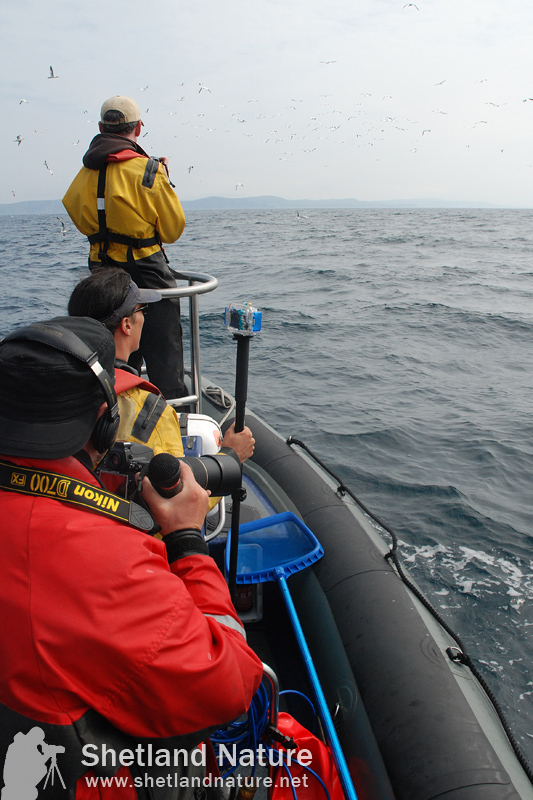
On Wednesday they headed back north to look for Orcas but to no avail. However, a Minke Whale was spotted at the mouth of Yell Sound. Thursday was better with some good sightings of Risso's again off Fetlar. With the weather blowing hard from the north on Friday we walked up to the point of Fethaland to do some monitoring from the shore.
Again if anyone has any sightings of killer whales or other cetaceans in the area please can they get in touch.
With this in mind, we will report that on Shetland Nature's Midsummer Cruise on board one of the Yell Sound ferries on Sunday, single Minke Whales were sighted twice at the south end of Colgrave Sound, and 2 White-sided Dolphins were seen in the same area.
Tuesday, 15 June 2010
Surveying cetaceans
Tuesday, 8 June 2010
Shetland’s first Iberian Chiffchaff
Sunday, 6 June 2010
The wanderings of a Hungarian Black Stork
On the stork's second day on Unst it went to roost on the cliffs in the late afternoon, and this gave us the opportunity to get close enough to read the ring. After a little effort we had it - 50P9.
It was probably first seen in Scotland on 8th May this year, when a Black Stork was seen flying over the Findhorn valley. All the sightings in Scotland are shown on the following Google map.
View Black Stork 50P9 in a larger map